Varieties · Tasting guide
A Spectrum of Oranges
Crimson, rose-pink, bitter, perfumed: the orange is not one fruit but a family of surprisingly different characters. Here is how to tell them apart — by eye, by nose and on the tongue.
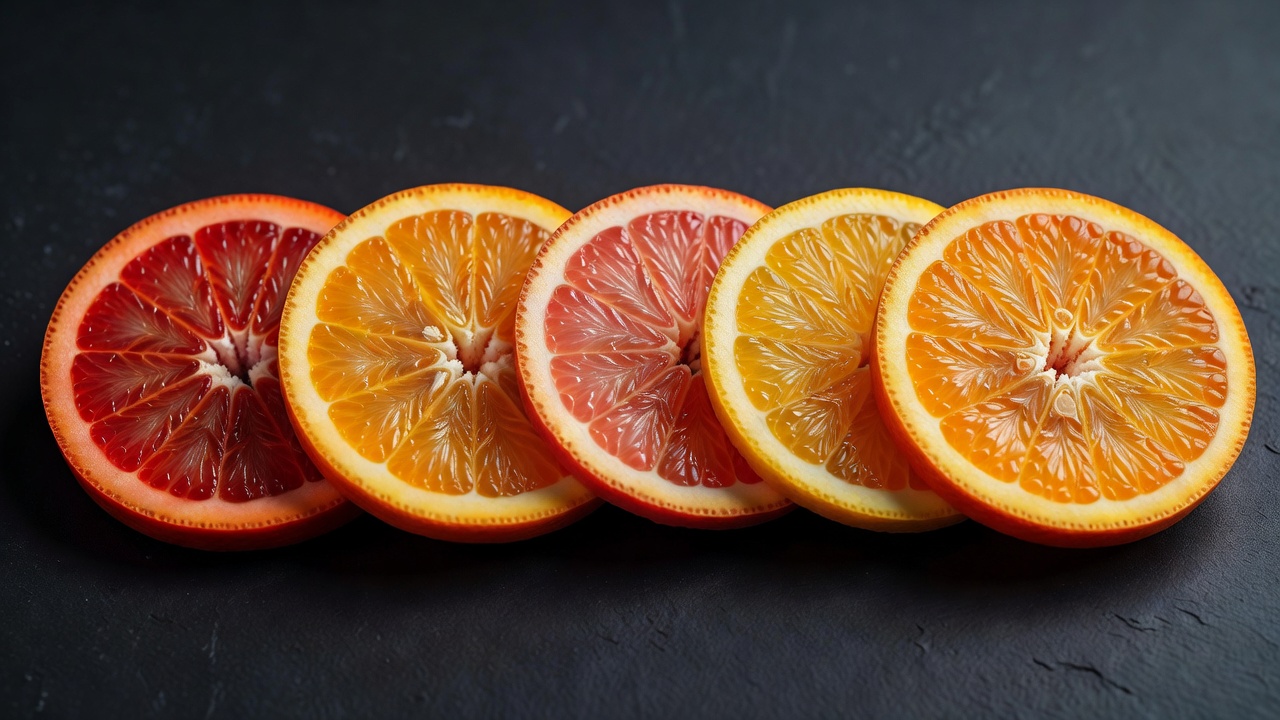
01 — Why oranges differClones, sports and lucky branches
Genetic studies suggest the sweet orange (Citrus × sinensis) arose from a cross between the pomelo and the mandarin, probably in southern China. Since then, almost all diversity in sweet oranges has come not from breeding but from "bud sports" — spontaneous mutations on a single branch. A grower notices a limb with redder flesh or fewer seeds, cuts budwood from it, and grafts it onto rootstock. Every tree of that variety descends from that one branch.
This is why oranges within a variety are so consistent, and why the differences between varieties can be dramatic: a mutation can switch on a pigment, lower acidity or change the timing of ripening. Climate then amplifies those traits, so the same variety can taste different in Sicily and in California.
02 — Blood orangesMoro, Tarocco and Sanguinello
Blood oranges owe their colour to anthocyanins, pigments that form only when warm days are followed by cold nights during ripening. The plain of Catania, below Mount Etna in eastern Sicily, has exactly that rhythm, and its blood oranges carry the protected designation Arancia Rossa di Sicilia.
Moro is the darkest, sometimes almost purple, with a flavour often described as raspberry or cherry and a faint bitter edge. Tarocco, Italy's favourite eating orange, has lighter red streaks, a thin peel and remarkable sweetness. Sanguinello, a Sicilian selection related to Spain's Sanguinelli, ripens later and offers balanced sweet-tart flesh with red flecks.
Cut a Moro on a cold February morning and the juice runs the colour of pomegranate.Tasting notes, Catania market
03 — Navels and pink fleshWashington and Cara Cara
The Washington navel began as a mutation in Bahia, Brazil, early in the nineteenth century. Budwood reached the US Department of Agriculture in 1870, and in 1873 Eliza Tibbets planted trees in Riverside, California. One of those original parent trees still grows at the corner of Magnolia and Arlington Avenues. The "navel" is a tiny second fruit at the blossom end; the variety is seedless and peels easily, but its juice can turn bitter if stored, so it is best eaten fresh.
The Cara Cara was found in 1976 at Hacienda Cara Cara near Valencia, Venezuela, as a sport of a navel tree. Its flesh is pink thanks to lycopene, the pigment in tomatoes and pink grapefruit. Expect low acidity and a sweet, almost berry-like finish.
04 — Bitter and aromaticSeville, bergamot and chinotto
The Seville orange (Citrus × aurantium) lines the streets of Seville, where the fruit is mostly exported for British marmalade. Its pectin-rich peel and high acidity make it ideal for preserves and savoury marinades. Bergamot, grown mainly along the Ionian coast of Calabria around Reggio Calabria, is prized for its peel oil, best known as the scent of Earl Grey tea. Chinotto, a small myrtle-leaved bitter orange from Liguria around Savona, lends its name to a dark, bittersweet Italian soft drink.
Bitter oranges, like grapefruit, contain furanocoumarins that can interact with some medicines. If you take regular medication, ask a pharmacist before eating them often.
05 — Juice oranges and modern hybridsValencia, Hamlin and Dekopon
The Valencia — despite its name, refined in nineteenth-century California and Florida — is the world's leading juice orange. It ripens late and can "regreen" on the tree in warm weather, its ripe peel taking back chlorophyll while the flesh stays sweet. Hamlin, an early Florida juice variety, is mild and seedless.
Among modern hybrids, Dekopon (Shiranui), bred in Japan in 1972 from Kiyomi and Ponkan, is recognised by its knobby top. It is sold in the United States as Sumo Citrus and is intensely sweet, juicy and easy to peel.
Compact tasting rows
- MoroDark red, berry notes, light bitternessDec–Mar
- TaroccoRed-streaked, very sweet, thin skinJan–Apr
- Washington navelClassic, seedless, balanced sweet-tartNov–Mar
- Cara CaraPink, low acid, rose and berry hintsDec–Apr
- ValenciaJuicy, bright, a few seedsMar–Sep
- SevilleSour, bitter, highly aromatic peelJan–Feb
- DekoponHoneyed, dense, easy peelJan–Apr
Seasons are typical Northern Hemisphere harvest windows and vary by region and year.